The Promise Story of Progress

Transformational change across organisations is essential to keep the promise. To understand the work and pace of change, Scotland needs an agreed way of tracking progress and to ensure it is felt in the lives and experiences of children, families, and the care experienced community. 

The Promise Story of Progress

What is the Promise Story of Progress?

Transformational change across Scotland is essential to keep the promise. To understand the work and pace of change, Scotland needs an agreed way of tracking progress and to ensure it is felt in the lives and experiences of children, families, and the care experienced community.

The Promise Story of Progress seeks to achieve this, by bringing together insights from three key questions that help us understand what’s happening nationally, across organisations and most important in the lives of children families and care experienced adults.

The purpose of The Promise Story of Progress isn’t to duplicate or add to existing reporting burden, but to help us collectively understand and demonstrate, in a richer and more human way, whether Scotland is truly keeping the promise. To do that meaningfully, we need to look beyond statistics, and see them in the context of experiences, voices, and qualitative insights that show what matters to children, families and care experienced adults and how change really feels.


Using this information

The Promise Story of Progress brings together evidence, learning, and voices that taken together help show how Scotland is keeping the promise. It connects what matters to children and families, what the care community is saying, what organisations are learning, and what national data shows about progress. Together, these perspectives help Scotland understand both how change is being made and what difference it makes to people’s lives.

Looking at a single question of the Promise Story of Progress will not help fully understand the journey of change- all three are interdependent and cannot be viewed in isolation:

  • Does the care community feel the impact of the promise being kept?
  • How is Scotland doing in its progress towards keeping the promise?
  • How are organisations doing in their work to keep the promise?

By drawing different types and levels of data and information together to answer these questions, The Promise Story of Progress seeks to enrich what can be understood from published data with what matters to children, young people and families to tell a more rounded story of the progress being made towards the promise.

To navigate across the three parts of the Promise Story of Progress, and the What Matters questions, use the navigation panels below.

National Progress
What Matters

To read about how The Promise Story of Progress has been and continues to be developed by COSLA, Scottish Government and The Promise Scotland in collaboration with others, click on the button below.

Building The Promise Story of Progress

Find out more about the milestones and next steps in The Promise Story of Progress in the data and information route-map

Timeline

FAQ's

The Promise Story of Progress has 3 essential parts, the national picture (also known as the promise progress framework) the organisational picture and the experience of the care community. Each part provides an important view, but only by bringing them together through the lens of what matters to children, families and care experienced adults can Scotland understand whether the promise is being kept. Each part offers a different kind of insight:

  • at a national level, the data shows what is changing
  • at an organisational level, learning shows how those changes are happening
  • The experience lens shows whether those changes are being felt 

On their own, each part provides one part of the story. Seen together, they help us understand what is happening, how it is happening and most importantly how its being felt by the care community. 

The what matters questions sit upfront an alongside the three parts of the Promise Story of Progress. They act as the lens that helps us understand what  ‘good’ looks like from the perspective of children, families and care experienced adults, not what ‘good’ looks like to the ‘system’. 

The information is organised across 10 vision statements. These are taken directly from the promise and relate to areas of life where children, young people and care experienced adults identified change needed to happen.

1.Supporting children to stay with their families.
Where children are in their families and feel loved, they must stay—and families must be given support together to nurture that love and overcome the difficulties which get in the way. (Promise report, Page 71)

2. Carers and stability.
Scotland must limit the number of moves that children experience and support carers to continue to care. (Promise report, Page 67)

3. Education.
Schools in Scotland must be ambitious for care experienced children and ensure they have all they need to thrive, recognising that they may experience difficulties associated with their life story. (Promise report, Page 71)

4. Brothers and sisters.
Where living with their family is not possible, children must stay with their brothers and sisters where safe to do so—and belong to a loving home, staying there for as long as needed. (Promise report, Page 9)

5. Physical restraint.
Scotland must strive to become a nation that does not restrain its children. (Promise report, Page 85)

6. Mental health and wellbeing.
Scotland must seek to uphold the wellbeing of care-experienced children and young people and ensure that there is timely access to mental health support before crisis point so that children can enjoy good mental health. (Promise report, Page 84)

7. Health.
Care experienced children and young people have access to support ensuring that their health needs are fully met and potential for good health is maximised. (Promise report, Page 89)

8. Justice.
Where children are in their families and feel loved, they must stay—and families must be given support together to nurture that love and Scotland must stop locking up children who have often experienced the failures of the state in the provision of their care. (Promise report, Pages 9 and 91)

9. Aftercare.
Young adults for whom Scotland has taken on parenting responsibility must have a right to return to care, and have access to services and supportive people to nurture them. (Promise report, Page 92)

10. Support for care experienced adults.
Care experienced adults must have a right to access to supportive, caring services for as long as they require. Those services and the people who work in them must have a primary focus on the development and maintenance of supportive relationships that help people access what they need to thrive. (Promise report, Page 92)

It has been developed in line with a set of five agreed key principles:

  1. Insights, not targets, driven.

    To help all those with a responsibility towards keeping the promise understand where progress is being made, the Promise Story of Progress is intended to enable a rich understanding of change to keep the promise.

  2. Focused on use and burden reduction.

    The Promise Story of Progress brings together different types of data from multiple sources into one place to aid understanding. Rather than setting up any new reporting requirements, this approach commits to using existing data sources, reducing the need for new data collection.

  3. Non-exhaustive.

    To help all those with a responsibility towards keeping the promise understand where progress is being made, the Promise Story of Progress is intended to enable a rich understanding of change to keep the promiseThe ten Vision Statements have been chosen based on available data from multiple sources, however, indicators are intended to evolve and expand as existing data improves and understanding deepens, alongside new sources of data, and research.

  4. Aligned.

    To help all those with a responsibility towards keeping the promise understand where progress is being made, the Promise Story of Progress is intended to enable a rich understanding of change to keep the promise. Through alignment with pre-existing frameworks, the Promise Story of Progress places data about care experienced children and families within the context of the wider population of children and families wellbeing at community level (the Children, Young People and Families Outcomes Framework) and national level data (the National Performance Framework).

  5. Expansive.

    The Promise Story of Progress collates different types of information across different sectors to understand progress towards outcomes. Wherever possible, data which has been collected since at least 2020 is used to measure progress. It integrates data from multiple sources and in many forms at different levels, using care experience markers where available.

The work to develop a national way to understand progress has been underway for some time:

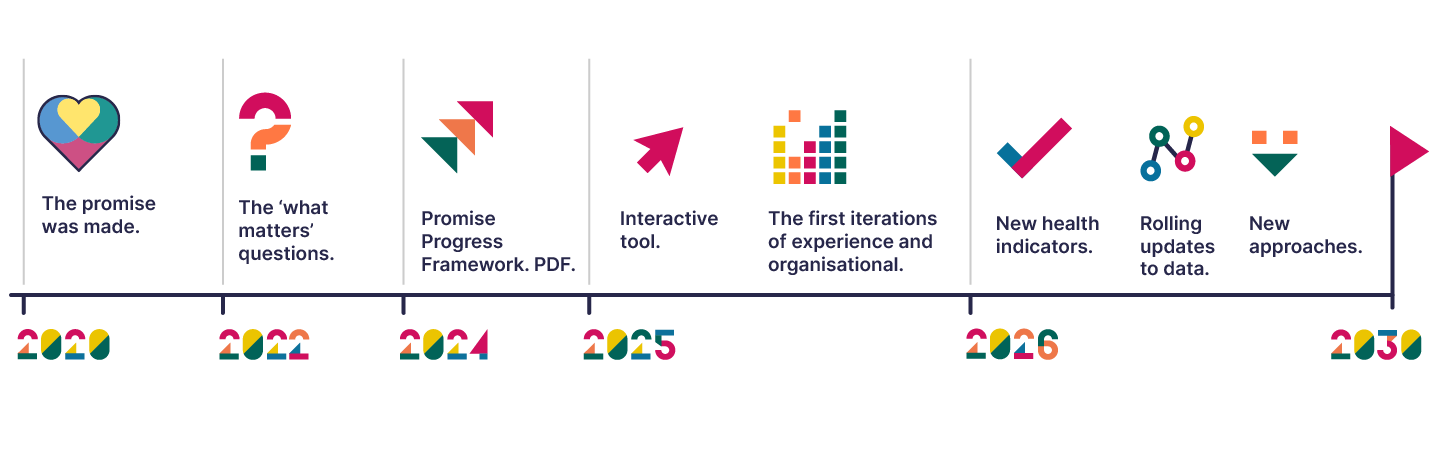
2020: The promise was launched and received cross-party support, following the Independent Care Review which heard from over 5500 voices.

2022: The ‘what matters’ questions are developed, based directly on what children and families told the Independent Care Review about what was important to them. They will help root Scotland’s understanding of what ‘good’ looks like through the experience of what makes a difference, rather than what ‘good’ looks like to the ‘system’.

2024: The Promise Story of Progress is launched, the first part of which is the Promise Progress Framework. This is published as a PDF.

2025: An interactive dashboard tool for exploring The Promise Progress Framework is launched.

2025: The first iterations of experiential and organisational parts of the Promise Story of Progress are launched, meaning for the first time there is information across the entirety of the story.

The Promise Story of Progress is hosted as a ‘Scotland owned’ output on the Plan 24-30 website. Maintenance and updating is shared between The Promise Scotland, the Scottish Government and COSLA.

The Promise Story of Progress is developed in a way that enables it to grow and develop over time, reflecting both the required shift for data to better reflect what matters to children, young people and care experienced adults, and the need to build approaches with support from organisations across Scotland.

2026: The Promise Progress Framework will be reviewed and updated to ensure outcomes and indicators remain relevant, and new data sources will be incorporated as they become available, including new health indicators.

2026: The Promise Progress Framework will begin a series of rolling updates to data.

2026: Updated versions of the organisational and experience parts of the Promise Story of Progress will be launched, building on learning developed in 2025. This will include working with multi-agency partners.